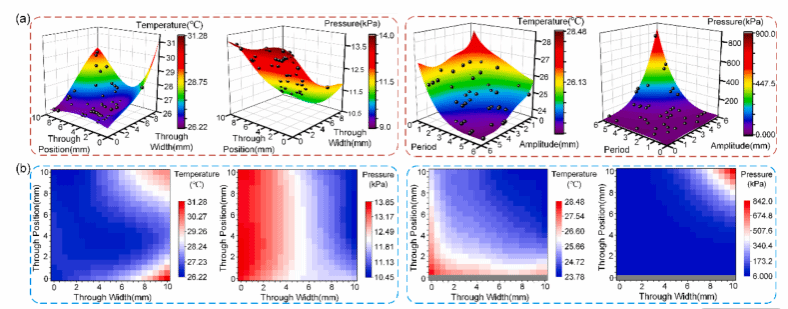
Microfluidic cooling technology has shown considerable potential in addressing the increasingly severe thermal management challenges of power electronic systems. However, most existing structural designs have not accounted for the constraint of a fixed heat transfer area, which limits the practical applicability and comparability of performance evaluations. In this study, the influence of different microchannel geometries on cooling performance is systematically investigated while keeping the heat transfer area constant. Four representative microchannel design schemes are selected, and the effects of structural differences on thermal management efficiency are examined in detail. Computational fluid dynamics (CFD) simulations are employed to evaluate the temperature distribution, pressure drop, Nusselt number, and thermal resistance as functions of flow rate, and the performance evaluation criterion (PEC) is used to comprehensively assess each design scheme. The experimental results show that, compared with the straight-channel design, the zigzag microchannel reduces the convective thermal resistance by up to 10%. Among the configurations, the dual-period zigzag structure achieves the highest PEC value. The CFD predictions agree well with the experimental data, with a maximum deviation of only 3%, verifying the accuracy of the model. In addition, through orthogonal experimental design combined with a multi-objective optimization algorithm, simultaneous optimization of the average heat source temperature and pressure drop is successfully achieved. The optimized schemes reduce the pressure drop of the through-flow channel (MC-C) by 14.4% and that of the dual-period zigzag channel (MC-D) by as much as 24.8%. This solution set offers flexible design alternatives whose priorities can be adjusted according to specific requirements. The study provides a practical methodology for microchannel design, and the results offer important guidance for thermal management strategies of high-heat-flux chips. The findings were published in Results in Engineering under the title “Thermal analysis and multi-objective optimization of equal-area microfluidic cooling systems”.